Candlesticks
Candlestick Trading for Beginners
A practice-first guide to reading candlesticks: anatomy, color, wicks, and context — with exercises and free interactive drills on real charts.
Updated 2026-06-15
Every chart you will ever trade is built from candles. Before patterns, indicators, or strategies mean anything, your eyes need to read a single candle quickly and correctly — and then read the story a sequence of candles tells.
That reading speed is a skill, not knowledge. You can memorize what “open, high, low, close” means in a minute. Reliably seeing who controlled a candle, at a glance, on a chart that keeps moving — that takes repetition. This page is the hub for building that skill: the concepts in learning order, each with its own practice page.
What this skill actually is
A beginner and an experienced trader can look at the same candle and see different things. The beginner sees a green rectangle. The trained eye sees where price opened, how far buyers pushed, where sellers fought back, and how the candle closed relative to that battle.
Candle reading is the foundation skill because everything else is built on it. Support and resistance, trend reads, and every named pattern are just structured ways of reading groups of candles. If single-candle reading is shaky, everything above it is shaky too.
The learning path
Work through these in order. Each one has a practice page with worked examples and self-test questions:
- Anatomy of a candlestick — open, high, low, close, bodies, and wicks. The vocabulary everything else uses.
- Candlestick anatomy quiz — check that you can label any candle’s parts without hesitating.
- Green vs red candles — what candle color actually shows, and why color alone is a weak signal.
- Candlestick reading practice — read bodies, wicks, and ranges together to judge who is winning.
After candlesticks, the natural next step is market structure — reading how candles combine into trends, support, and resistance.
Common beginner mistakes
The first mistake is reading color as a signal. Green means the close was above the open; red means the close was below the open. That is useful, but it is only the first clue. A green candle with a long upper wick may show buyers lost control before the close. A red candle with a long lower wick may show sellers pushed lower and got rejected.
The second mistake is reading one candle in isolation. A long lower wick at support and a long lower wick in the middle of a noisy range are not the same message. Candle reading always asks where the candle formed, what came before it, and whether the next candle confirms or denies the read.
The third mistake is jumping to named patterns too early. Pin bars, engulfing candles, and inside bars are built from the same body, wick, range, and close information. If those basics are not automatic, pattern names create confidence faster than skill.
How to practice this without risking money
Reading about candles builds familiarity, not skill. The skill comes from reps: look at a candle in context, commit to a read, get told whether you were right, repeat on a fresh chart.
That loop is hard to run alone — when you grade your own answers, it is easy to be generous. Guided drills that check your actual answers remove that bias. The market will also happily train your candle reading, but it charges real money for each lesson. Practicing first is the cheaper path.
What improvement looks like
At first, improvement feels slow because you are naming every part deliberately: open, close, high, low, body, wick. That is normal. The first milestone is speed: you can look at any candle and instantly know which side controlled the body and which side, if any, was rejected.
The second milestone is comparison. You stop reading candles one by one and start comparing body size, wick size, and range against nearby candles. That is when a quiet candle after expansion, or a first rejection wick after a clean move, starts to stand out.
The third milestone is context. You can read a candle and immediately ask whether it formed at a useful location. That is the bridge from candlestick basics into chart reading practice and eventually candlestick patterns practice.
A simple candle-reading routine
Use the same routine every time until it becomes automatic. First, identify the body. A large body means one side made progress from open to close. A small body means the period ended near where it began, even if price moved around inside the candle.
Second, read the wicks. A long upper wick means price traded higher and failed to stay there. A long lower wick means price traded lower and failed to stay there. Do not jump straight to “bullish” or “bearish.” Say what happened first.
Third, compare the candle with its neighbors. A candle that is large relative to the last ten candles carries more information than the same candle inside a volatile sequence. Expansion, compression, and rejection are relative ideas. You cannot judge them from one candle alone.
Fourth, place it on the chart. A rejection wick at a defended level is different from the same wick in the middle of a range. A strong close in the direction of a trend is different from a strong close after a long exhausted move. Location changes the meaning.
How this connects to patterns
Most named patterns are shortcuts for candle-reading stories. A pin bar is a failed excursion. An engulfing pattern is a two-candle reversal of control. An inside bar is compression inside the previous range. If the underlying candle story is clear, the pattern name becomes useful. If the story is not clear, the name can become a trap.
For that reason, practice candlesticks before pattern hunting. When you can explain a candle without using a pattern name, pattern pages become easier and safer. You will see why some textbook examples matter and why many clean-looking examples should be skipped.
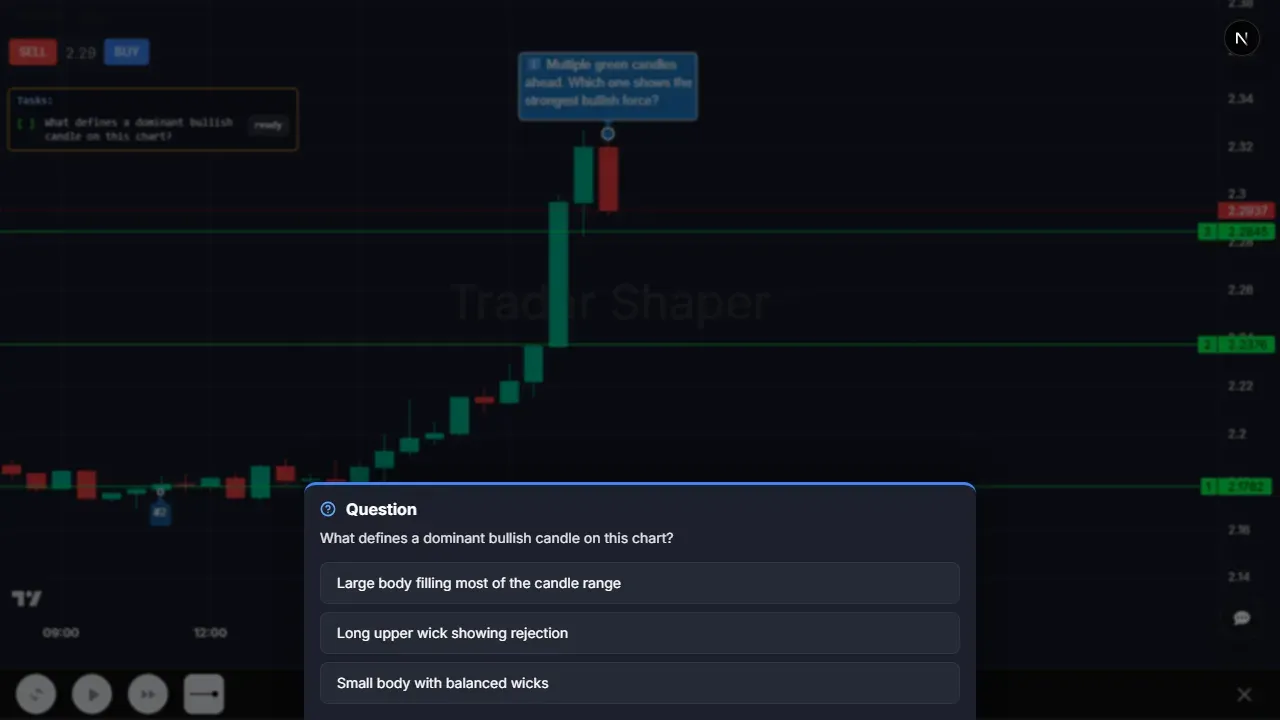
Interactive practice
Build the skill step by step
Trader Shaper turns concepts into short chart tasks, progress checkpoints, and simulated decisions.
Start learning free