Candlesticks
Candlestick Reading Practice
Practice reading candlesticks beyond color: bodies, wicks, and ranges together. Worked examples and self-test exercises with answers, then real-chart drills.
Updated 2026-06-15
Once you know candle anatomy, the next skill is judgment: looking at a candle — or a short sequence — and answering “who’s winning, and how convincingly?” Not as a memorized pattern name, but as a read of the actual battle.
This is where candle color stops being the answer. Green doesn’t mean buyers are winning; it means the close was above the open. Whether that’s strength, weakness, or indecision depends on the body, the wicks, and what came before. If you haven’t read green vs red candles, start there.
What you are training your eyes to see
Three measurements, combined, tell the story of any candle:
- Body size — conviction. A dominant body means one side controlled the period; a tiny body means a stalemate.
- Wick placement — rejection. A long wick marks an excursion that failed: someone pushed price there, and someone else pushed it back.
- Range vs neighbors — energy. A candle twice the size of its neighbors carries information; one lost inside the previous candle’s range often signals compression.
And one rule above all three: read the candle where it happened. A long lower wick at a defended support zone is a meaningful rejection. The identical candle in the middle of nowhere is just noise. Candles are sentences; location is the context that gives them meaning.
Worked examples
Example 1 — strong but stretched. Five large green candles in a row, each closing near its high. Conviction is obvious. But the fifth candle is the widest of the series and far from any pullback — strength reads differently when it’s the fifth sentence of the same speech. Trained eyes see strength and extension at once.
Example 2 — the quiet warning. After a steady advance, a candle with a tiny body and long upper wick appears. Nothing dramatic — but buyers tried to continue and got fully rejected for the first time in the move. The next candle’s job is to confirm or deny. Reading “first rejection after a clean run” is more useful than knowing the shape’s nickname.
Example 3 — big wick, wrong place. A dramatic lower wick prints mid-range, far from any level. A beginner sees “rejection — buyers stepping in!” The trained read is a shrug: rejections matter where there’s something to reject from. Without a level, a wick is just volatility.
How to practice the read
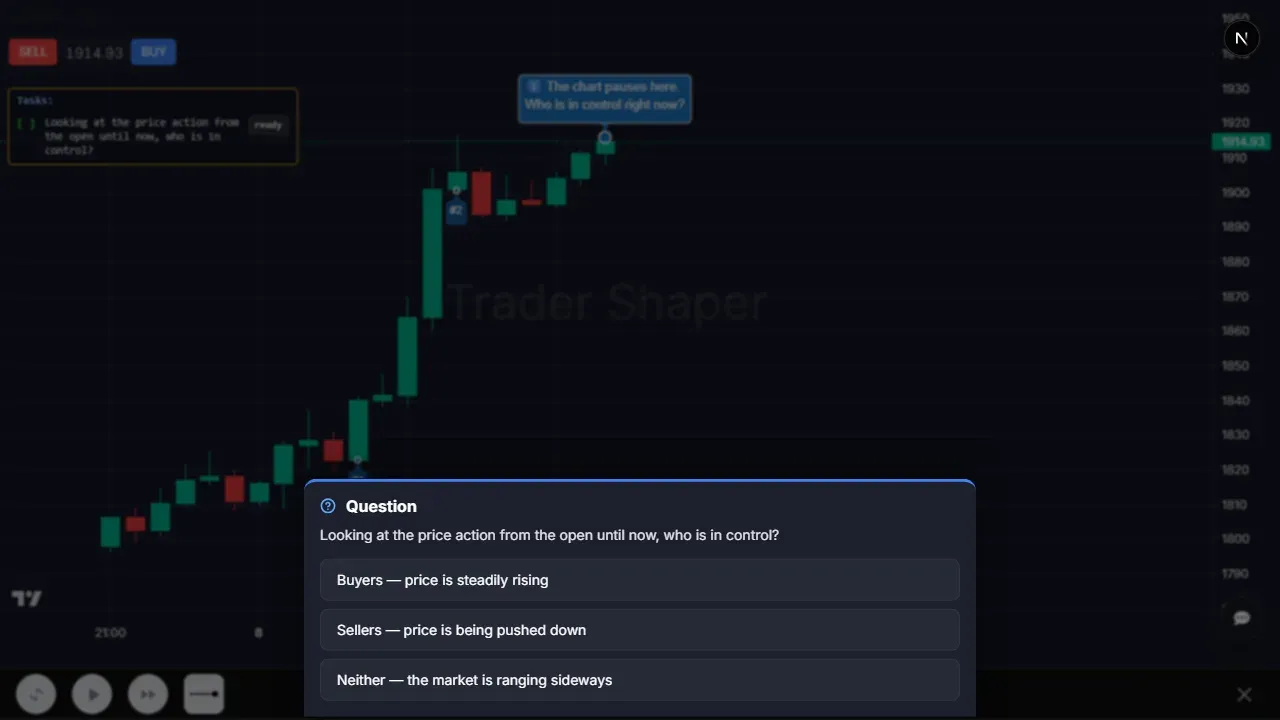
Pick one candle and say the read out loud before looking right. Start with the body: did one side make meaningful progress from open to close, or was the body small? Then read the wicks: which side tried to extend and failed? Finally, compare the whole candle with the candles around it. Is it louder than the recent action, quieter than the recent action, or just another average candle?
The key is to separate observation from prediction. “Buyers closed near the high after rejecting the low” is an observation. “This must go up” is a prediction. Good candle practice builds observations first, because predictions without accurate observation become guesses with confident language.
After single candles feel easier, move to short sequences. Ask whether the last three to five candles show expansion, rejection, compression, or exhaustion. Most useful chart reads come from a sequence, not a single famous shape.
Sequence reads beat isolated candles
One candle can give useful information, but the stronger read usually comes from the sequence around it. A long upper wick after a clean rally is different from a long upper wick after three failed rallies. A small candle after expansion is different from a small candle after days of sideways movement.
When reviewing a sequence, start with the direction of pressure. Are bodies mostly closing higher, mostly closing lower, or overlapping? Then check whether the ranges are expanding or contracting. Expansion means the market is moving with more energy. Contraction means the market is compressing or waiting.
Next, look for the first change in behavior. The first candle to close poorly after a strong advance matters more than the fourth weak candle after everyone can already see the slowdown. The first failed push into support matters more than a random wick in the middle of a range. Train yourself to notice the shift, not just the final obvious result.
This is why practice examples should include both clean and messy charts. Clean charts teach the ideal. Messy charts teach discrimination. In live trading, discrimination is the more valuable skill.
What a good practice answer sounds like
A weak answer is only a label: “bullish candle,” “bearish wick,” or “possible reversal.” A good practice answer explains the evidence. For example: “buyers closed near the high after rejecting the low, but the candle is mid-range and not at support.” That answer separates the candle’s strength from its location.
Another good answer might be: “sellers produced three large bodies, but the last candle left a lower wick into prior support, so selling pressure is still present but no longer clean.” This kind of sentence is longer than a pattern name, but it is much more useful. It gives you something to check after the next candles print.
Write answers this way until the structure becomes natural: control, rejection, comparison, location. That order keeps the read grounded in observable chart information.
Checklist: reading any candle
- Body: who controlled the period, and how decisively?
- Wicks: which excursions failed, and which side defended?
- Range: is this candle louder or quieter than its neighbors?
- Location: is this happening at a level that gives it meaning?
Test yourself
Commit to a read before opening each answer.
1. A green candle closes well off its high, leaving a long upper wick. Bullish or bearish information?
Show answer
More bearish than its color suggests. Buyers pushed price up but couldn't hold the highs — sellers absorbed the advance. Color says 'up,' the wick says 'and then they were stopped.' What happens next, and where this printed, decides how much it matters.
2. After a long decline, a candle prints with a small body and a very long lower wick right at an area that acted as support before. What's the read?
Show answer
A meaningful rejection candidate. Sellers extended the decline into a defended area and were pushed back hard. The location upgrades the wick from noise to information. It's still one candle — the read is 'watch for confirmation,' not 'buy.'
3. A candle's entire range fits inside the previous candle's range. What is the market doing?
Show answer
Compressing. Neither side extended beyond the prior period's battle lines — activity contracted. These pauses often precede expansion, but direction isn't predetermined; the information is 'energy is coiling,' and the resolution candle tells you the rest.
4. Three consecutive candles each have large bodies in the same direction with almost no wicks. What's the read, and what's the trap?
Show answer
The read is genuine, one-sided control — clean conviction. The trap is extrapolation: the cleaner and longer the run, the later in the move you probably are. Strength and sustainability are different judgments; beginners merge them.
Frequently asked questions
Does a green candle always mean buyers are in control?
No. Green only means the close was above the open. A green candle with a long upper wick shows buyers losing the highs; a tiny green body shows stalemate. Control is read from body size, wick placement, and range — not color alone.
Why does the same candle pattern work in one place and fail in another?
Because candles get their meaning from location. A rejection wick at a defended support zone reflects real positioning; the same shape mid-range reflects nothing in particular. Reading candles without reading their location is the most common pattern-trading error.
What's the fastest way to improve candle reading?
Structured reps with feedback: look at real candles in context, commit to a read, get corrected, repeat. The skill is perceptual — like reading X-rays — and it responds to corrected practice, not to memorizing more pattern names.