Practice
Chart Reading Practice for Beginners
How to practice reading trading charts without risking money: a deliberate practice routine, self-test exercises with answers, and free interactive drills.
Updated 2026-06-15
Most beginners try to learn trading by watching videos and reading threads, then wonder why live charts still feel like chaos. The missing piece isn’t another concept. It’s that chart reading is a perception skill — closer to reading X-rays or chess positions than to memorizing facts — and perception skills are built one way: repeated practice with feedback.
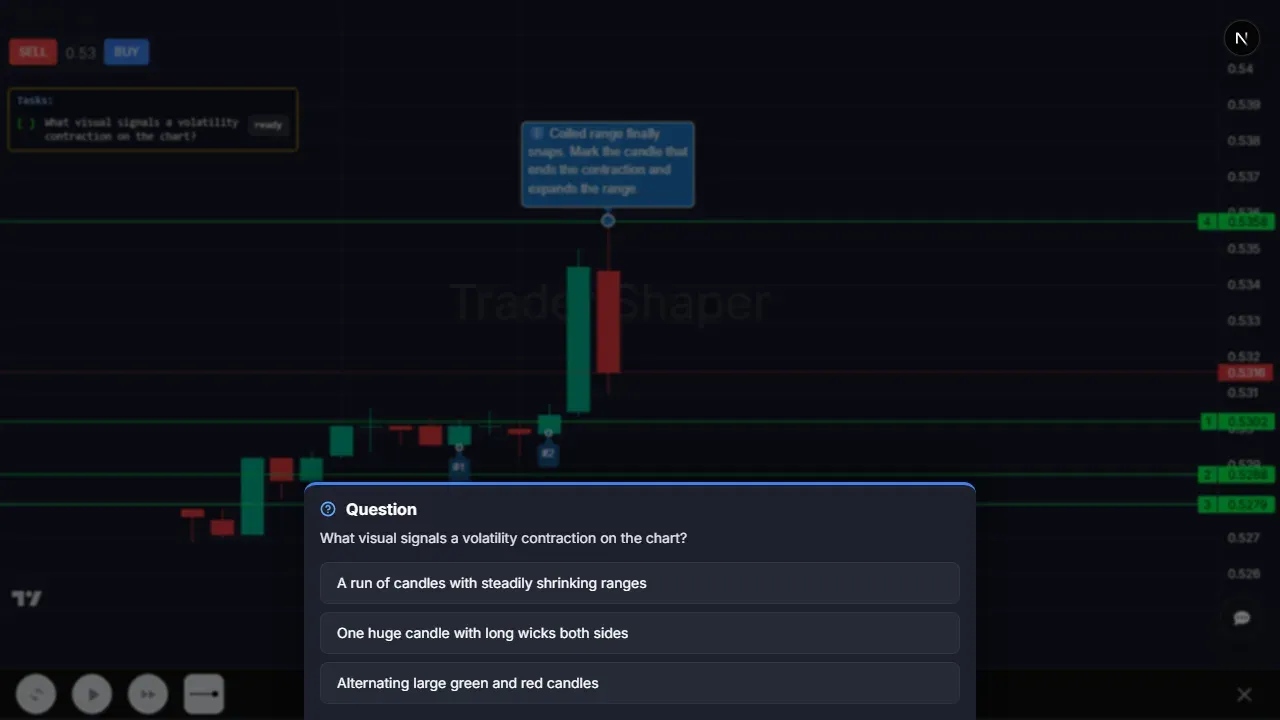
This page gives you a practice routine you can start today, a self-test to locate your gaps, and links into free interactive drills that check your answers on real charts.
Why reading about charts isn’t practicing charts
When an experienced trader looks at a chart, they don’t scan candle by candle. Years of reps have trained their visual system to compress the chart into structure: trend, swing points, defended levels, and the current candle’s role in that story. Beginners see all the data and none of the structure — every candle looks equally important, every wiggle looks like a signal.
No amount of reading transfers that compression. You can know every definition and still freeze on a live chart, because knowing and seeing are different systems. The market will train your seeing eventually — but it charges real money per lesson. Deliberate practice first is the cheaper path.
A practice loop that actually works
Effective chart practice has four parts. Remove any one and it stops working:
- Fresh charts. Hindsight makes familiar charts look obvious. Practice on charts you haven’t seen, where the right edge is genuinely unknown to you.
- A committed answer. Mark the trend, the swings, the levels — concretely, before anything confirms you. Vague “looking at charts” trains nothing.
- Feedback. Your answer gets checked. Self-grading is generous; an external check is honest. This is the step almost everyone skips, and it’s the one that builds the skill.
- Volume. One deep analysis a week loses to twenty corrected reps a day. Perception is statistical — your brain needs many examples to learn the pattern behind the pattern.
Run that loop daily, even for ten minutes, and the chart starts to feel slower within weeks. Not because the market changed — because your filtering did.
A 10-minute daily drill
Use a short session so the practice is easy to repeat. Open a fresh chart and hide the future if you can. Spend the first minute naming only the environment: trend, range, or transition. Do not draw entries yet. If the environment is unclear, write “unclear” and explain why. That answer is better than forcing a trend because you want one.
Spend the next three minutes marking the obvious swing highs, swing lows, and one or two levels. Keep the marks sparse. If you need more than a few lines to explain the chart, you are probably marking noise. The purpose of the drill is to compress the chart into the information that matters.
Spend the next three minutes reading the current candle or current sequence. Is price expanding, rejecting, compressing, or drifting? Write one sentence that starts with observation, not prediction: “price is testing resistance and closing off the high” is useful; “price will dump” is not.
Use the final minutes to check your read against what happened next or against a guided lesson. Mark the miss clearly. Was the problem trend classification, bad level selection, candle overconfidence, or ignoring context? One named mistake is more valuable than five vague notes.
What to write down during practice
Chart reading improves faster when the answer is written before the reveal. Keep the notes short: trend or range, important swings, key level, candle read, and one reason for the answer. The point is not to create a trading journal. The point is to force a clear read that can be checked.
Bad practice sounds like “it might go up, but it could go down.” Good practice sounds like “sideways range; price is returning to the upper boundary; last candle shows upper-wick rejection.” The second version can be reviewed. If it is wrong, you can see which part failed.
That clarity matters because most beginner mistakes are not one big misunderstanding. They are small, repeated misreads: calling pullbacks reversals, marking every pause as a level, treating every candle pattern as a signal. Written answers expose those habits faster than passive chart watching.
How to review your mistakes
Do not review misses as “wrong direction.” Direction is usually the least useful label. Review the component that failed. If you called an uptrend but the chart was sideways, the trend filter failed. If you marked a level that price ignored, the level-quality filter failed. If you saw a long wick and treated it as reversal without checking location, the candle-context filter failed.
This review turns a bad read into a training signal. Over time you should see repeated categories. Maybe you overvalue the most recent candles. Maybe you mark too many levels. Maybe you like reversal patterns and see them before the structure supports them. Those repeated categories are the actual curriculum.
Keep a short list of your top two errors and practice against them directly. If you over-mark support and resistance, force yourself to mark only two zones. If you misclassify trends, begin every session by marking only swings. Practice improves fastest when the next rep targets the last real mistake.
Where to focus first
Practice in this order — each skill is the foundation of the next:
- Candle anatomy — instant OHLC reading.
- Candle reading — bodies, wicks, and who’s winning.
- Trend identification — uptrend, downtrend, sideways.
- Swing highs and lows — the turning points that define structure.
- Support and resistance — marking the levels that matter.
- Patterns in context — pins, engulfings, and when shapes mean something.
Test yourself
A quick placement test. If any answer surprises you, that topic is where your practice should start.
1. You open a chart you've never seen. What's the first question to answer, before any candle or pattern?
Show answer
Trending or ranging — and based on the swing sequence, not the last few candles. Almost every other read (levels, patterns, entries) changes meaning depending on that classification, which is why structure comes before candles in the reading order.
2. Why does practicing on charts you've already studied feel productive but train very little?
Show answer
Hindsight contamination. Once you know how a chart resolves, every signal looks obvious and your brain rehearses recognition of the outcome, not discrimination under uncertainty. The skill you need lives at the right edge of an unseen chart.
3. What's wrong with practicing without anyone checking your answers?
Show answer
Self-graded reads drift generous — ambiguous calls get remembered as correct. Without honest feedback the loop reinforces existing habits, including the wrong ones. Corrected reps are what separate practice from repetition.
4. A friend says they'll learn chart reading 'live, with small positions.' What's the actual cost of that plan?
Show answer
They're paying the market for perception training: every misread costs money and, worse, the emotional noise of losses corrupts the feedback signal. Risk-free reps build the perception first, so live trading tests execution rather than basic seeing.
Frequently asked questions
Can I practice trading without real money?
Yes — and for chart reading specifically, you should. Perception skills are built through repetition and feedback, neither of which requires capital at risk. Guided drills on real historical charts give you the reps; live money then tests execution and psychology on top of a trained eye.
How long does it take to learn to read charts?
With daily corrected practice, basic structure reading typically starts feeling automatic within weeks, not years. The timeline depends almost entirely on rep volume and feedback quality — passive video-watching doesn't move it.
What should chart reading practice consist of?
Fresh charts, committed answers (mark the trend, swings, and levels concretely), feedback on those answers, and volume. Ten minutes of corrected reps daily beats hours of passive analysis.
Is a trading simulator enough to learn trading?
A simulator teaches order mechanics, but most beginners' losses come from misreading the chart, not from mis-clicking orders. Perception training — graded chart reading drills — addresses the actual bottleneck. Trading remains risky regardless; training reduces avoidable mistakes, it doesn't guarantee outcomes.