Patterns
Engulfing Pattern Practice
Engulfing candle exercises with answers: what a real bullish or bearish engulfing shows, when it matters, and worked examples — then drill it on real charts.
Updated 2026-06-15
An engulfing pattern is two candles telling a story of overthrow: the second candle’s body completely covers the first one’s, in the opposite direction. One period’s verdict gets fully reversed in the next. That’s why traders watch it — it’s a visible shift of control.
Like every pattern, it’s taught as a shape and misused as a shape. The same two candles can be a genuine power shift or routine noise, and the difference is everything around them. This page trains the difference.
What you are training your eyes to see
A bullish engulfing: a red candle, then a green candle whose body opens at or below the red body and closes above it — buyers didn’t just win the period, they erased the sellers’ previous one. Bearish engulfing is the mirror.
What separates signal from noise:
- Relative size. A large body engulfing a tiny one proves little — engulfing a normal or large candle is what shows real force.
- Location. A bullish engulfing at a defended support zone or a trend’s higher low is a story. The same shape mid-range is two candles that happened to overlap.
- What it interrupts. The pattern is most informative when it cleanly reverses a directional push — sellers pressing into a zone, then fully erased.
- The close. A close near the engulfing candle’s extreme shows the winners kept control to the end; a long opposing wick weakens the verdict.
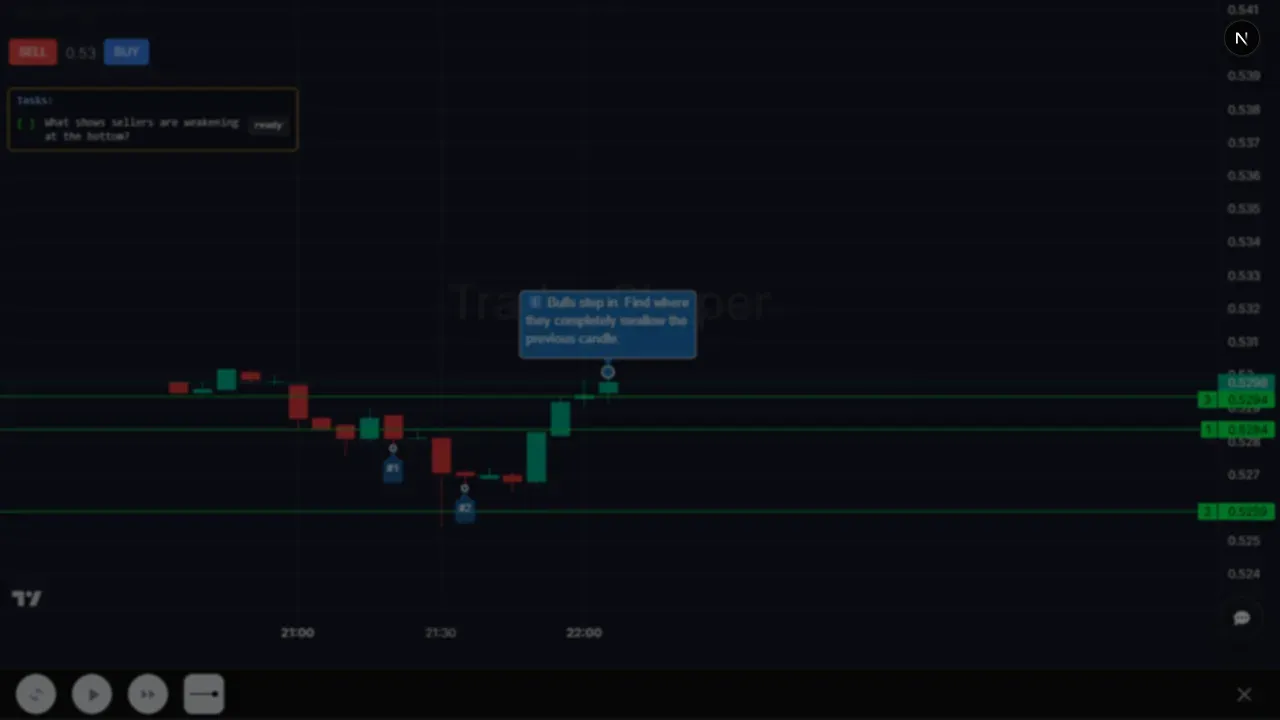
What to notice in the app screenshot
The useful part of the screenshot is the label near the green candle: buyers step in and completely swallow the previous candle. That is the core engulfing idea. The page is not asking you to memorize the picture; it is asking you to see the sequence: sellers push first, then buyers erase that candle’s body and change the short-term read.
Worked examples
Example 1 — the real overthrow. A downtrend leg presses into an area that bounced price twice before. A red candle pushes in; the next candle opens lower, then closes above the entire red body, near its own high. Sellers committed, got absorbed, and buyers reversed the verdict at a defended zone. This is the configuration worth recognizing at a glance.
Example 2 — engulfing a whisper. A doji prints — a tiny body, a stalemate. The next candle, perfectly average, technically engulfs it. The pattern-scanner says “engulfing!” The trained eye says: overpowering a stalemate proves nothing. Relative size is the first filter, and this one fails it.
Example 3 — right shape, exhausted context. After eight green candles, a final bullish engulfing prints far above any support. Technically valid, but who is left to overthrow? Late-trend engulfings often mark enthusiasm’s peak rather than its beginning. Location in the move matters as much as location on the chart.
How to practice engulfing patterns
Start by checking the candle being engulfed. If the first candle had a tiny body, the second candle did not reverse much. Engulfing a weak or undecided candle is less meaningful than engulfing a candle that showed real control by the other side.
Next, check the location. A bullish engulfing after sellers pushed into support tells a coherent story: sellers had control, reached a defended area, and then buyers fully reversed the prior body’s verdict. The same shape in the middle of a range has less information because there is no obvious battle line.
Finally, check the close. An engulfing candle that closes near its extreme shows the winning side held control into the end of the period. A large opposing wick says the power shift was challenged immediately. That does not erase the pattern, but it lowers the quality of the read.
Engulfing patterns as a change in verdict
The easiest way to understand an engulfing pattern is to compare the two candle bodies as two verdicts. The first candle says one side won that period. The second candle says the opposite side won so strongly that it erased the prior body’s result.
That is why engulfing a meaningful candle matters more than engulfing a tiny one. If sellers printed a strong red candle into support and buyers then produced a larger green body that fully covered it, the market’s short-term verdict changed. If the first candle was a doji, there was not much verdict to overturn.
The same idea helps with bearish engulfings. A strong green candle into resistance can show buyers pressing. If the next candle fully engulfs that body and closes near its low, sellers did more than pause the move; they reversed the prior period’s result.
Practice describing the verdict change before naming the pattern. “Buyers erased a meaningful red candle at support” is a richer read than “bullish engulfing.” It includes size, direction, and location in one sentence.
Follow-through after an engulfing
An engulfing candle is a strong claim, but the next candles decide whether the market accepts it. After a bullish engulfing, watch whether price can hold above the midpoint or high of the engulfing candle. If the next candle immediately gives back the entire move, the power shift was not accepted.
After a bearish engulfing, watch whether buyers can reclaim the engulfed area. If they do, the bearish verdict weakens. If price continues lower or retests the engulfing body from below, sellers have follow-through.
This keeps the pattern from becoming a fixed belief. The engulfing candle gives you evidence. Follow-through tells you whether that evidence is being confirmed or rejected by the next participants.
Checklist: does this engulfing matter?
- The engulfed candle had a meaningful body — not a doji or micro-candle.
- It printed at a location worth fighting over: a level, zone, or structural swing.
- It cleanly reverses a directional push, not sideways drift.
- The engulfing candle closes near its extreme, keeping the verdict intact.
Test yourself
Commit to a read before opening each answer.
1. A green candle engulfs a doji mid-range. The textbook says bullish engulfing. Your read?
Show answer
Pass. Engulfing a doji means overpowering a stalemate — there was no opposing verdict to reverse, so no power shift is demonstrated. Relative size is the first validity filter, and engulfing a micro-body fails it.
2. A bearish engulfing prints at a resistance zone after three green candles pushed into it. The engulfing candle closes on its low. Quality of this signal?
Show answer
High, as engulfings go. It has everything the pattern wants: a real directional push to reverse, a defended location, meaningful engulfed body, and a close at the extreme showing sellers held control. Still a hypothesis — but a well-formed one.
3. Does the second candle need to engulf the first candle's wicks too, or just the body?
Show answer
The classical definition is body engulfs body — the wicks record failed excursions, while the bodies record the periods' verdicts, and the pattern is about reversing a verdict. Engulfing wicks as well is a stronger showing, but body-over-body is the core requirement.
4. A bullish engulfing forms at support, but the engulfing candle has a huge upper wick and closed in its middle. What's the concern?
Show answer
The verdict didn't hold. Buyers overpowered the prior candle but then gave back half their gains within the same period — that upper wick is sellers answering immediately. The 'overthrow' ended contested, which meaningfully weakens the pattern's claim.
Frequently asked questions
What is a bullish engulfing pattern?
A two-candle pattern: a red candle followed by a green candle whose body completely covers the red candle's body. It shows buyers fully reversing the previous period's outcome — a visible shift of control, most meaningful at defended levels.
Does an engulfing candle need to engulf the wicks?
The standard definition requires engulfing the body only, since bodies represent each period's settled outcome. Covering the wicks too is a stronger version, but body-over-body is what defines the pattern.
Why do engulfing patterns fail so often?
Usually because they're traded as shapes: engulfings of tiny candles, engulfings in the middle of nowhere, or engulfings late in an extended move. The pattern only carries information when there was a real verdict to reverse, at a location worth fighting over.